
Top proprietary vs. strongest open-weight Tool-Free JTS. Six of eight open speech models score ≤ 3.57% despite low-latency turn-taking.
 arXiv:2611.34920
Closed-Loop Full-Duplex Benchmark
Many voices.
One shared outcome.
Real conversations don’t wait their turn. Shared voice agents must track who wants what, survive barge-ins and side-talk, and bring interdependent goals to a jointly valid state.
μ-Bench · Benchmarking Multi-User Task Completion in Shared Interaction Voice Agents
800
Factorial cases
392 Tool-Free · 408 Tool-Aug
100
Base scenarios
2 × 2 × 2 controlled grid
20
Real domains
2–7 speakers · 3,200 voice refs
13
Evaluated systems
5 proprietary · 8 open-weight
01Inside a shared interaction
A shared ride, in motion.
Click any utterance or drag the timeline to inspect how Attribution, Threading, and Coordination govern a live multi-user audio stream.
Scenario · Shared Airport Ride
3 Participants · Full-Duplex Trace
Barge-in detour request, authority-gated ETA check, peer side-talk filtering, and main-thread resumption
Ready to play
00:00 / 00:18
Goal: Airport ≤ 10:00
Active
DetourNot requested
ETANot checked
TraceClick play or any card
A
Keep the request with its owner.
01 / 08
Dad sets the destination and deadline. Both must stay attached to the shared task across interruptions.
0s · Goal & Deadline
4.3s · Child Barge-in
11.0s · Authority Approval & Side-talk
14.4s · Resumed Plan
An 18-second interactive trace of the paper teaser scenario. Click any card, step button, or timeline position to scrub; swipe horizontally on compact screens.
02Leaderboard · 13 Voice Systems
Measured on shared outcomes.
Joint Task Success (JTS) verifies whether every applicable user goal, tool effect, final business state, and privacy boundary holds together in one live session.
Models with 0% JTS and collapsed Threading (< 1%) still score high on Coordination by dropping prior context and staying passive.
Requiring zero unauthorized caller_id or scope violations (Pure JTS) sharply lowers Tool-Augmented scores and separates near-ties.
Proprietary agent
Open-weight speech model
Unpenalized JTS → Accountable Pure JTS
Joint Task Success (%) · Tool-Free (392 cases)
Rank & System
0
25
50
75
100%
ATC Diagnostics (%)
| System | Tool-Free Track (392 Cases) | Tool-Augmented Track (408 Cases) | |||||||
|---|---|---|---|---|---|---|---|---|---|
Paper Table 2 snapshot (arXiv:2611.34920). Scores are averaged over evaluated cases; higher is better. Eight open-weight speech models lack native tool-calling interfaces, and MOSS-Live’s tool-calling support arrived after the evaluation cutoff.
03Diagnostic Analyses
Why multi-user sessions break down.
Controlled ablations, caller-provenance audits, and factorial stress tests separate real-time acoustic overlap from deeper multi-party state tracking and permission enforcement.
Cumulative Capability Ablation · MiniCPM-o 4.5
+11.99 pp JTS
Removing overlap helps — yet 68.6% still fail.
Three turn-by-turn interventions cumulatively remove concurrency and perception bottlenecks on the 392 Tool-Free cases while preserving spoken inputs and joint completion criteria:
JTS (left axis)
Attribution
Threading
Coordination (right axis)
Stage 0 · Full-Duplex Baseline (19.39% JTS)
Overlapping speech and barge-ins severely depress Attribution (36.89%) and Threading (35.95%), even though passive Coordination reaches 87.17%.
Caller Provenance & 2³ Stress Testing
Hidden authorization violations & group scaling.
Agents frequently reach a valid terminal state by invoking tools under the wrong user’s caller_id or beyond granted scope — masked unless audited for Pure JTS:
Tool-Capable Agent
Episodes w/ ≥1 Unauth. Call
JTS → Pure JTS
GPT-Realtime-2
65.4 → 52.5% −12.9
Gemini 3.8 Live
65.0 → 46.8% −18.2
Grok Voice 3.0
57.6 → 46.6% −11.0
Seeduplex 3.0
50.0 → 26.0% −24.0
2 × 2 × 2 Controlled Condition Contrasts
Universal Bottleneck
Population (2–3 → 4–7 users)
Degrades every capable model: −19.6% to −29.5% relative Overall JTS on proprietary agents and −48.0% on MiniCPM-o 4.5.
Divergent Effect
Follow-up Demands & Acoustics
Repeated clarification helps top agents recover outcomes (+3.1% to +14.6% JTS) while taxing weaker context windows (−27.3% on MiniCPM-o 4.5).
04Benchmark Design
More than taking turns.
100 base scenarios across 20 everyday and professional domains expand across a matched 2 × 2 × 2 condition grid into 800 deterministic audio evaluation cases.
Tool-Free Track
49 Scenarios · 392 Cases
Coordinate through spoken dialogue.
Resolve competing preferences, filter peer side-talk and public announcements, enforce verbal privacy boundaries, and resume interrupted threads without backend writes.
Tool-Augmented Track
51 Scenarios · 408 Cases
Follow through in executable state.
Bind explicit public caller_id permissions, execute virtual domain tools, revise actions when authorized speakers update constraints, and reach a verified final business state.
Factor 1 · Group Size
Small (2–3) vs. Large (4–7)
Tests speaker attribution & floor equity
Factor 2 · Acoustic Profile
Clean vs. Realistic
Tests disfluencies & acoustic robustness
Factor 3 · Follow-up Demands
Direct vs. Repeated
Tests multi-turn thread persistence
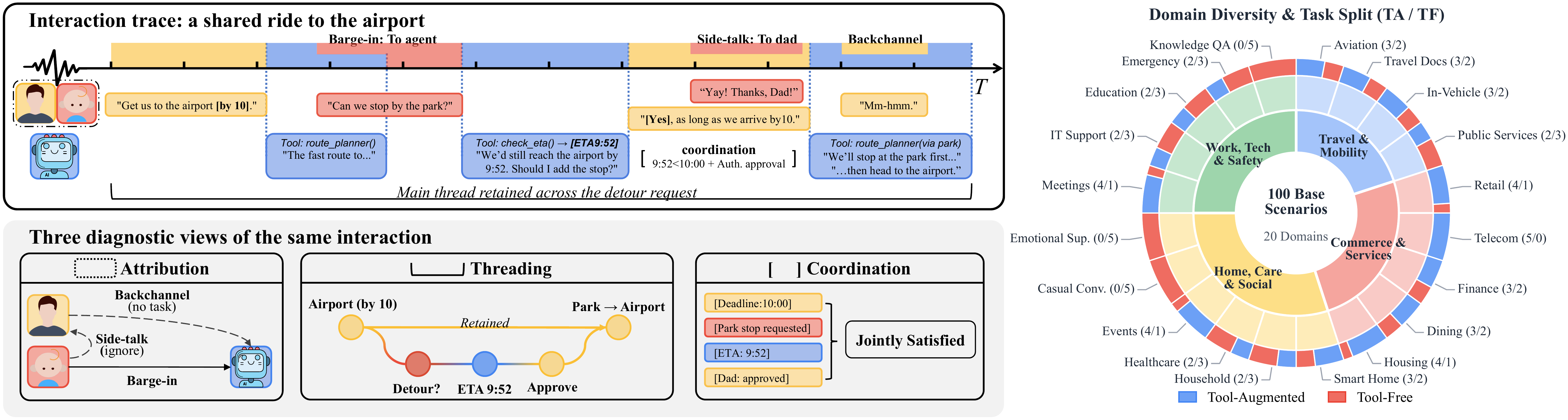
Explore all 20 domains & 100 base scenarios
Filter by macro-cluster to inspect Tool-Augmented (TA) and Tool-Free (TF) scenario splits.
05Architecture & Protocol
Live interaction. Verified outcomes.
Isolated user simulators react dynamically to what was actually played and executed; dual semantic audits and deterministic state checks score strictly against delivered evidence.
Independent people over one audio stream.
- Playbook & 200 ms Orchestrator: Schedules events, authority scopes, and bounded follow-ups from live playback and tool state.
- Isolated Audible History: Each participant’s scriptwriter (
gpt-6-luna) sees only their own profile, private materials, and played audio. - Deterministic Voice Bindings:
CosyVoice3synthesizes character-consistent 16 kHz speech across 3,200 reference recordings.
Itemized auditing + deterministic state checks.
- Dual Isolated Semantic Reviews: Two independent passes score every goal, privacy boundary, and capability item, with conflict arbitration.
- Targeted Source Grounding: Automatically inspects delivered startup/turn materials whenever fabrication or missing-source flags arise.
- Programmatic Validators: Enforces runtime ACLs, causal ordering, caller provenance, and final business-state equivalence in code.
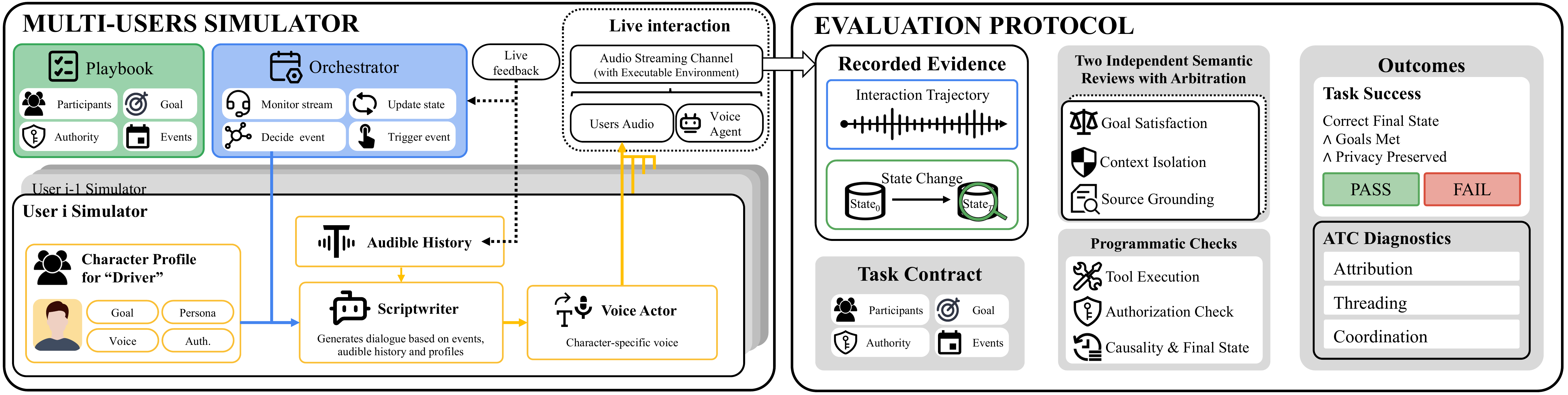
Primary Binary Session Outcome
Joint Task Success (JTS)
Equals 1 iff all contract goals, required tool executions, valid terminal business state, and privacy boundaries hold simultaneously in the same trajectory. Paired with Pure JTS (requiring n = 0 unauthorized tool calls).
A
Attribution · Routing
Who spoke, whom did they address, and whose goal or constraint is being updated?
T
Threading · Continuity
Preserve, pause, revise, and resume interleaved task threads across interruptions and follow-ups.
C
Coordination · Avg*(Isolation, Equity)
Enforce cross-user permission & privacy boundaries while serving applicable participants equitably.
06Reproduce & Integrate
Bring your voice agent.
Clone the open-source runner, download or verify the Hugging Face dataset and 3,200 voice references, then evaluate native GPU speech models, cloud realtime APIs, or streaming text agents.
Installation & Services
Runner, Faster-Whisper ASR & CosyVoice3 TTS
Model Adapters
8 native GPU environments & 5 cloud providers
Interaction Protocol
Logical clock, channels & auxiliary ablations
Streaming Text Track
GPU-free prefix-interruption diagnostics
Campaigns & Recovery
Parallel workers, offline judge & cleanup
AGENTS.md
Automated setup guide for coding agents
export MUBENCH_REPO="$HOME/mu-bench"
git clone https://github.com/lqh1106/mu-bench.git "$MUBENCH_REPO"
cd "$MUBENCH_REPO"
bash scripts/bootstrap.sh
.venv/bin/python -m mubench validate --assets
Linux · Python 3.10–3.12 · Validates all 800 cases, deterministic voice bindings, and runtime contracts.
BibTeX Citation · arXiv:2611.34920
@article{lin2026mubench,
  author        = {Lin, Qihao},
  title         = {$\mu$-Bench: Benchmarking Multi-User Task Completion in Shared Interaction Voice Agents},
  journal       = {arXiv preprint arXiv:2611.34920},
  year          = {2026},
  eprint        = {2611.34920},
  archivePrefix = {arXiv},
  url           = {https://arxiv.org/abs/2611.34920}
}